When I found out baby #4 was on the way, I didn't even think about whether I would breastfeed or not. I knew I would.
Before I'm labeled as a judgmental breastfeeding mom, let me assure you that I've experienced both worlds.
Dylan was 100% formula fed, and I have no regrets. He's very smart and he has a top-notch immune system. He may have quite a few ER visits under his belt for injuries (he is a boy, after all), but formula didn't harm him in any way!
Lexie and Lily were exclusively breastfed. I just wanted to try, and it ended up working well for us! I nursed Lexie for 11 months, and I nursed Lily for 14 months. They both weaned when they were ready to be done.
After nourishing 3 children, I knew what choice was right for our fourth child. Breastfeeding was convenient and free, so it was the clear winner!
I expected to hold my 4th baby right after he/she was born, and to immediately start breastfeeding. What I didn't expect was to have my baby taken away from me, and to be told that there was a very good chance that my baby had Down syndrome. That I already knew. I knew it the moment his eyes met mine.
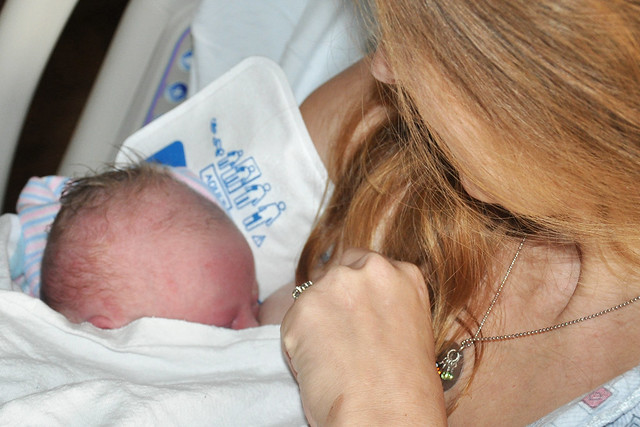
Breastfeeding Liam for the first time was nothing like I imagined it would be.
My memories of that day are foggy. I remember all the feelings, but I
can't remember the timeline. At some point, Liam was back in my arms,
and in that fog, it registered that I had to feed him. I lifted him to
my breast, and tried to get him to latch on. I remember staring down at
him and watching my tears drip onto the top of his head. He was so foreign to me, and didn't feel like my baby. I just wanted to wake up from the nightmare I was living.
After a few minutes, it was evident that breastfeeding Liam was not going to be the easy experience I anticipated. He was so sleepy and his latch was so weak. The lactation consultant came in, smiled, said it was obvious I knew what I was doing, and walked back out. I wanted to run after her screaming, "NO! I don't know what I'm doing! I have NO idea how to feed a child who has Down Syndrome!"
I fell in love with Liam in the wee hours of the morning. As I stared
into his eyes, the fog and the grief lifted. I vowed to love him and
protect him, and give him the best life I possibly could. Once again, I
lifted him to my breast and I just kept trying to get him to latch on
and stay latched on. We did it over and over and over again until it was time to
leave the hospital. I was determined to make it work.
When another lactation consultant stopped by before we left, I asked so many questions about breastfeeding a baby who has Down Syndrome, and my questions were brushed off. I'm not quite sure if she just didn't know how to answer, or if she, along with many others, were unsure as to whether he had Down syndrome or not. Either way, I knew I was on my own.
Four weeks later, the lab results were finally in. Liam did have Down syndrome. At that point, I expected the news.
The first month of breastfeeding was a big struggle. Although I really did know what I was doing, Liam was extremely sleepy, and waking him to eat was nearly impossible at times. His weight began to plummet. Newborns are supposed to sleep a lot, but he truly slept 22 hours a day. I later found out that this was a VERY common issue in newborns who had Down syndrome.
When Liam was a few days old, we went to
the doctor for a weight check. He was still under his birth weight. We
returned a few days later, and he still hadn't gained any weight. Liam's pediatrician did not want me to give up breastfeeding, but she recommended we return to the lactation consultant to get a supplemental feeding device. The lactation consultant made
sure he was nursing properly (he was) and showed me how to use the
device.
Every time I breastfed Liam during the day, I used the device, which was filled
with high calorie formula. At every feeding, he got breast milk and
formula at the same time. He continued with the weekly weight checks
and his weight continued to drop. It definitely wasn't a supply issue,
because I pumped regularly and I was producing plenty.
When Liam was 5 weeks old, he finally woke up. He stayed awake for longer periods of time, he wanted to eat often, and breastfeeding clicked.
However, at 2 months old, Liam was still under his birth weight of 7 lbs 11oz. He was
nursing very well by that point, but not gaining any weight. He had his first
appointment at the Down Syndrome Clinic, and even thought he looked
great, the doctor was concerned enough about his weight to hospitalize
him for some tests.
We had our first encounter with the feeding team during our 3 day stay. Every single member of the feeding team informed me that a baby who had Down Syndrome could not breastfeed effectively. They watched him breastfeed, and tried to come up with reasons as to why he wasn't doing it properly, but failed.
When that didn't work, they insisted he must be aspirating, and told me I
would have to quit breastfeeding if he was. They began to force a bottle into his mouth, and it truly was the most unnatural thing to watch. Moments before, he was serenely breastfeeding. Then, they ripped him off the breast, shoved a bottle in his mouth, and continued to force it into his mouth as he screamed, kicked, and flailed. They shrugged, said we'd see what the test results showed and insisted I bottle feed him. As soon as they walked out the door, I
started to cry. I knew I would do what was best for my child, but
after a lot of research, I felt like breast milk was the best option.
At
that moment, Liam's wonderful pediatrician called. She reassured me
that I should not give up on breastmilk, even if he was aspirating. She
said the feeding team would insist that breastmilk could not be
thickened properly in a bottle, but it was possible. I hung up the
phone and breathed a sigh of relief.
After many tests, some of which were very invasive and involved him
being put under general anesthesia, they were unable to find a cause for
his low weight. With the exception of discovering mild reflux and
mild Laryngomalacia (floppy vocal chords/airway), everything checked out
perfectly. We were sent home with medication for the reflux and we were
told to ditch the supplemental feeding device, continue to breastfeed, and start supplementing with bottles of high calorie formula.
I wanted Liam to start gaining weight because he was so tiny, but he had a very difficult time drinking from a bottle. It took him over
an hour to drink 2 ounces once he settled down enough to drink. Within a week of leaving the hospital, Liam
started Occupational Therapy. His amazing therapist (who is still with us!) got him to drink properly
from a bottle 5 minutes after she arrived! Liam continued to breastfeed
the majority of the time, but we supplemented with 1-2 bottles of high
calorie formula a day.
Despite the supplemented bottles of high calorie formula, weekly weight checks with his pediatrician, and weekly OT sessions, Liam's weight still stayed low. He reached his birth weight just after he turned 2 months old. At that point, he began to gain, but the gain was very slow, and often dipped or plateaued.
I began to question if all these extra feeding methods were unnecessary. His heart was completely fine, and I was repeatedly told that babies who had Down syndrome used so many more calories than a "typical" child did just to do simple things. Liam began rolling early, and lifting his head up early, so it made sense that he was using a lot of calories. Plus, many kids with Down syndrome had the same issue as he did. Fighting the bottle was most likely wasting a LOT of calories.
Just before 4 months old, Liam began to flat out refuse his supplemental bottle. His OT and pediatrician agreed that he was expending more calories fighting off the bottle than he was actually taking in. When he breastfed, he was calm and thorough. We were given the go ahead to stop all bottles of high calorie formula, and to exclusively breastfeed. We stopped fighting with him to force calories into his body, and just let him be. He KNEW how to breastfeed.
Shortly after turning 4 months old, Liam began watching other people eat and reaching for
utensils. After a month passed, and his interest remained, Liam's OT and pediatrician recommended starting solids. Armed with a list of high calorie foods, we started with one
solid feeding a day. After hearing many horror stories about feeding babies who had Down syndrome solids, we expected the worst. Liam, however, did better than my "typical" babies!
It was at
that point that Liam finally began to gain! His pediatrician and OT
always felt that Liam's slow gain was due to him burning off almost as
many calories as he consumed. Breastfeeding became easy for him, but
he had to work harder to take the bottle. When we made the switch to
exclusively breastfeeding and giving him one solid meal a day, he gained
an entire pound in a month. That was more gain than ever before!
We were thrilled with his progress, and we were confident that this was the best feeding method for him!
At 6 months old, Liam returned to the Down Syndrome Clinic. He had FINALLY
reached 10 lbs. The pediatrician and OT were thrilled with his weight
gain, but his stats weren't even on the growth chart. Liam's
doctor at the Down Syndrome Clinic recommended a visit with the feeding
team again. We were not looking forward to meeting with the feeding
team, but we loved his doctor, and knew he didn't want to miss something that could be causing the slow gain. So off we went.
Prior to the appointment, Liam's OT told us everything the feeding team
was going to say. She worked on the team prior to switching to in-home
therapy. She explained that they were very anti-breastfeeding. She explained how they would say babies with Down Syndrome couldn't breastfeed, and they
would insist that we switch to formula feeding.
The appointment was worse than we ever imagined. A pediatrician, speech
therapist, occupational therapist, and nutritionist were in the room
with us. They spent the entire hour talking over each other and talking
over us. They didn't even look at Liam as an individual. They treated
him like he had every possible characteristic of Down Syndrome. They
watched me breastfeed him for 30 seconds, then told me that
breastfeeding was not an effective feeding method for children with Down
Syndrome. They refused to watch him eat solids and said he simply couldn't do it. The nutritionist was the only one who tried to help us with
our current feeding plan, but she was flat out told that it wasn't an
appropriate solution. They told me to stop solids, stop breastfeeding,
and just give him bottles of thickened formula until he was 1.
By that point, my head was pounding. I explained that he was not
aspirating liquids, and I inquired about how we were supposed to just
feed him bottles of thickened formula when HE WOULDN'T TAKE A BOTTLE.
They replied that he was just going to have to learn. The speech
therapist came over at that point, made the thickened bottle, and
repeatedly tried to shove it in his mouth. Poor Liam was sputtering,
gagging, and crying, and I couldn't help but wonder how this harsh
method was better than the relaxing, easy way he breastfed.
I was furious and my husband was ready to flip out. I just
nodded my consent so we could leave as quickly as possible. As we
walked down the hallway, he asked me if I was really going to take those
fools seriously. I looked at him, smiled, and said, "Absolutely not.
I'm not changing anything."
I didn't change a single thing.
I was producing enough milk and Liam was
breastfeeding effectively. Liam continued to breastfeed and eat one
solid meal a day. He went to weekly weight checks and had weekly
sessions with his OT. A nutritionist came to our house once a month to
weigh him and make suggestions on what high calorie foods he should eat.
All three medical professionals were pro-breastfeeding and they were
Liam's biggest supporters. He gained a pound each month. I knew we were
doing the right thing.
At 9 months old, his nutritionist said she was thrilled with the way he
was eating and gaining. He was released from her care. At that point,
his pediatrician said he didn't have to come in for weight checks
anymore. His issues with reflux and laryngomalacia were even resolving on their own! After 9 months of weekly weight checks, we were elated!
At his 1 year appointment at the Down Syndrome Clinic, Liam's doctor was
very happy with his weight gain. Liam was finally on the Down syndrome chart. Very
low on the chart, but finally following his own curve! He asked if the
appointment with the feeding team helped, and I told him the truth:
that following my gut, cutting out all the unnecessary intervention, and
just letting him breastfeed was what helped. I knew he was doing it
right and I knew fighting with him to take a bottle was doing more harm
than good. Once we relaxed and just let him be, he started to gain!
Liam was still breastfeeding at age 1, he was eating 3 solid meals a day, and thanks to his Occupational Therapist's guidance, he was already beginning to self feed. At his 1 year well exam, his pediatrician suggested that I continue to breastfeed him through the winter. I always assumed I would start weaning at 12 months, just like I did with Lily, and be done by 15 months. I never really thought about extended breastfeeding, but Liam was still a very tiny 15 pounds, and I didn't think it could hurt. I took her advice without a second thought.
Liam is now 21 months old. He is still very small. At his last visit with the pediatrician, she told us that he's now the size of a typical 9-12 month old boy. I feel like we wasted so much time searching for a problem that didn't exist, instead of just letting him do what came naturally. He's small. He's meant to be small. Many other children with Down Syndrome are small. I say he's just tiny but mighty!
Liam did continue to breastfeed through the winter. As winter ended, I decided to let him wean on his own. He cut back to just a short morning and evening nursing session, which eventually progressed into just a short evening nursing session. At 21 months, Liam still nurses a few evenings a week for just a few minutes. He's rapidly losing interest and I know very soon his breastfeeding days will just be a distant memory.
Thanks to previous breastfeeding experience, following my gut instinct, and trusting the medical professionals who believed in Liam, we were able to achieve something HUGE.
They said he couldn't do it. I said he could.
Liam is an incredible eater, and has always been ahead of the Down
Syndrome curve when it came to feeding milestones. He's gaining
consistently, and although he hasn't even made it onto a typical growth
chart, he's maintaining his own curve. He's happy, he's meeting all his milestones, he's healthy, and
he's THRIVING.
I wish I could face the feeding team just one more time. I would tell them that they were wrong. I would remind them to look at a child with Down Syndrome as an individual instead of just labeling them with every possible characteristic. I would show them my happy, healthy boy with the most contagious smile and tell them that breastfeeding was ABSOLUTELY the right choice for him.
I'm glad I didn't listen to the people who didn't know my boy. I'm glad I listened to the people who did. And I'm proud of myself for trusting my gut and giving him the gift of 21 months of breast milk!
This was just my story to tell. Everyone has their own story and a different set of experiences. No story is right or wrong.
Although there are many babies with Down Syndrome who do have
feeding issues, there are those who can and do breastfeed effectively.
Sadly, many medical professionals tend to push formula feeding, because it's just easier. My hope is that this post will help
another mother who finds herself in a similar position.
It IS more difficult to breastfeed a child with Down Syndrome. They tend
to be harder to wake at the beginning and their suck is a lot weaker
due to low muscle tone. With determination, support, and lots of
practice, it is very possible to succeed. I know there are obstacles to
overcome, but it can work. When safety is an issue, such as aspiration, formula is
absolutely the right choice.
No matter what feeding choice you make, with love and proper nutrition, your child will thrive!
{This post was inspired by a guest post I shared on The Breastfeeding Diaries. We've come a long way since Liam was 13 months, and I never expected he could go this long! I'm so glad he did!}